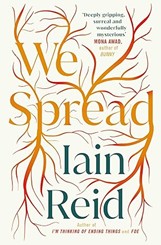
 Iain Reid’s We Spread is an unsettling novel which explores themes of ageing and identity. The existential element is as relevant in this novel as in Reid’s earlier novel, I’m Thinking of Ending Things which became a huge commercial success.
Set in a secluded care home, the novel follows Penny, an artist who has moved into long-term care following the death of her partner. Despite her initial opposition, Penny begins to enjoy her new home, though she has suspicions that it is too good to be true. Although seemingly innocuous at first, small changes in routine and the behaviour of the staff at the home begin to unsettle Penny and she becomes increasingly mentally fragmented and confused. None of the residents, of which there are only three others, are allowed to go outside, and Penny begins to lose sense of time. The obvious assumption is that Penny is suffering from dementia, but Reid increases the ambiguity by suggesting that something more sinister could be happening at Six Cedars.
The blurring of reality within the narrative reflects Penny’s confusion, and the reader is left to interpret whether she is mentally deteriorating or actually witnessing something real and unsettling. The writing is itself fairly fragmented, deliberately disorienting the reader and adding to the psychological mystery. Even the layout of the text on the pages of the book, chunks of space in between sentences, is symbolic of missing pieces, fragmentation.
Told in first person by an unreliable narrator, it is easy to really get inside Penny’s head, and the confusion she describes is almost tangible and heartbreaking, though the narrative is often very slow paced. This can work well in terms of allowing reflection, but it can also lose momentum at times. In the end, the absence of an answer to the ambiguous question of Penny’s sanity leaves an uncertainty which only the reader can decide.
There is a moment in which Penny seems to embrace the unreliability of the mind: ‘We each have our own memories and experiences, even if they’ve been lost and forgotten.’
Reid has explained his thinking on the novel’s ending: “I know what I think, but I won’t tell anyone what it is. I want people to make their own interpretations.” Lovers of interpretive fiction will relish an ending devoid of any clear-cut answers, and if that was Reid’s intention, he really delivers.