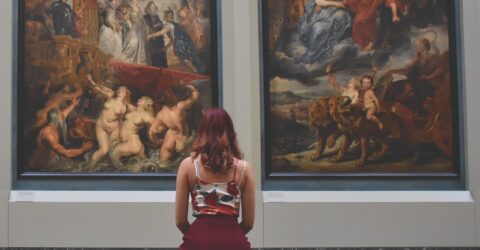
It is a very human trait to turn to art at those moments when life becomes hardest to interpret. The structures that organise our days can often feel as though they are loosening – certainty falters, language feels insufficient, and emotion can feel too big. That is when we often reach, almost instinctively, for something with a familiar shape and form. A novel. A painting. A piece of music. A poem which seems to understand what we are experiencing.
This movement is not accidental, nor is it merely habit. It suggests that art is not a tertiary accompaniment to human life, but one of the quiet mechanisms by which we preserve our inner coherence. Beneath the surface of our busyness and competence, there is a part of us continually seeking orientation and deeper ethereal meaning.
We often speak of art as enrichment, something that refines experience or adds texture to an already stable existence. But this framing understates its role. Again and again, people turn toward literature, image, and sound, not when life is easy, but when it is fragile. We read late into the dark nights, using the quietest of times to reach deep into our psyche. We examine and analyse paintings, sensing without fully understanding that something in their stillness has an effect on us. We replay certain songs because they seem to help process confusing thoughts and feelings. We believe we are using these processes as distraction, but it is really to remind us that we are not singular or alone.
Art becomes a form of companionship and relatability across time, cultures, gender, age, religion, and experience. Our private intensities belong to the broader human story.
In this way, art performs a regulatory function that is rarely acknowledged outright. Where raw experience can feel chaotic, art introduces form. Where emotion threatens to overflow, it offers containment. A novel lends narrative shape to suffering; a poem distils grief into language precise enough to be held; music gives rhythm to what might otherwise remain overwhelming. Through these encounters, the psyche finds not escape, but structure.
This may help explain why, in periods of universal uncertainty as well as personal upheaval, we use artistic works to express how we feel. We recommend books to one another not only because we enjoyed them, but because they have carried us through something. Certain passages remain with us for years, not as quotations to display but as internal landmarks. They become places we return to when our own thoughts feel less certain.
To say that we turn to art because something in us is trying to stay alive is not to suggest that life without art is impossible. Engagement with art is not necessary for fulfilment. But for those who feel its pull, an absence of art can feel as if something is missing. The world seems slightly less dimensional, less interpretable, less shared.
Perhaps what art protects is our capacity to feel without being judged, to reflect without being misunderstood, and to recognise ourselves as participants in a human drama far older and larger than our individual biographies. It reminds us that our interior life matters. Over time, the works that matter to us form a kind of invisible architecture in our soul. We carry them quietly, remembering them when it is appropriate – a line remembered during a difficult conversation, a scene that pops into our head unexpectedly while walking, a song that relaxes the nervous system. They accompany us not as pieces of knowledge which we have picked up along the way, but as internal supports.
None of this requires that we need to articulate what a painting or a novel makes us feel every time we reach for it. It manifests as a feeling, not a verbal expression. Something in us recognises the meaning we have attached to it.
In a culture where importance is placed on speed and variety of information, turning toward art can appear unnecessary, even self-indulgent. Yet this view overlooks the complexity of the human interior. We are not sustained by efficiency alone. We require spaces in which ambiguity is allowed, where feeling can unfold without immediate resolution, where we can sit with our feelings and responses for longer than three seconds. Art, literature, and music, offer such a space
This is why we should always continue to turn toward it, even if we don’t quite know why we are drawn there. We don’t need to be especially cultured or discerning, but some attentive part of the psyche understands what we need on a deeper level. Beneath our roles and routines, something in us is always leaning toward what might help us remain awake to our own lives.
To live without ever encountering the shaping force of art would be to move through the world with fewer mirrors. When we are particularly confused or low, that can actually seem preferable. But with fewer chances to see our inner weather reflected back to us, our ability to gain clarity is affected. When we allow ourselves to encounter art, and allow it to permeate our soul, we can become more conscious and self-aware. It won’t be a miracle cure-all, but it will steady us in a storm.